
People vs. Technology: Why CX Transformation Needs Both
Customer experience leaders everywhere face a familiar, maddening reality:
They invest in great tools, but transformation stalls.
They invest in training their teams, but little sticks.
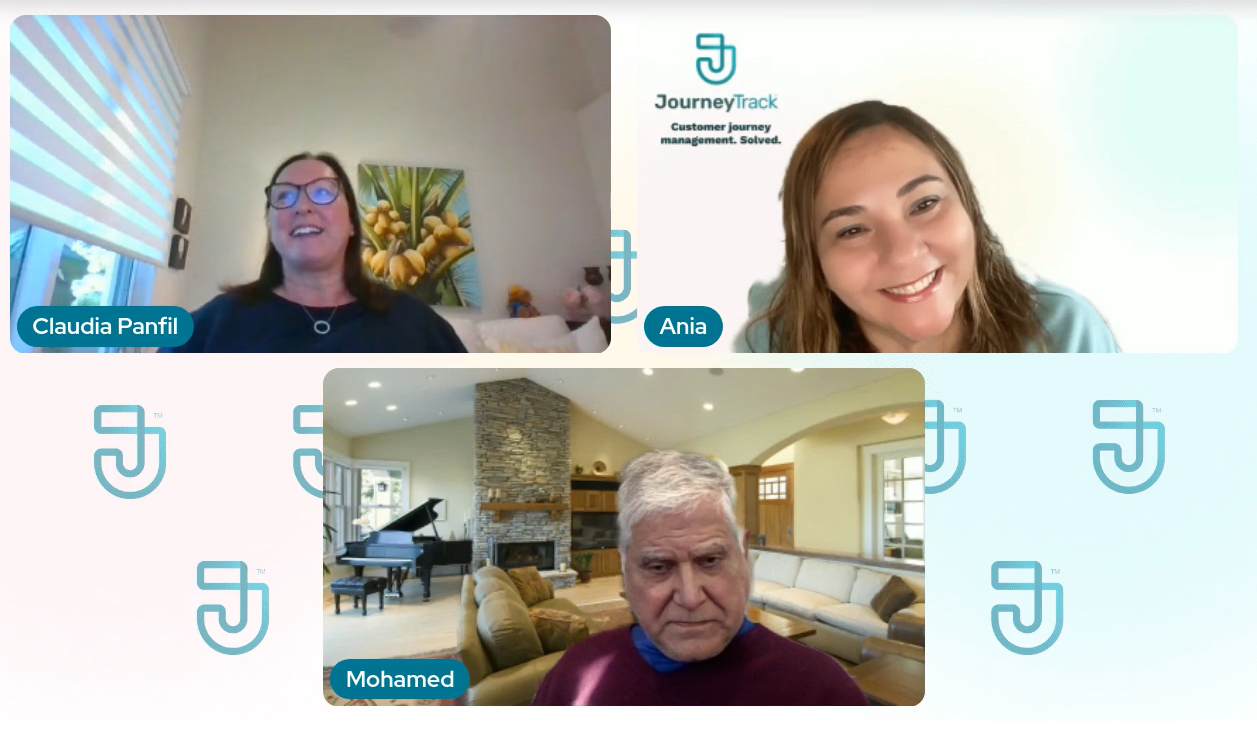
During our recent webinar, People vs. Technology: Why CX Transformation Needs Both, JourneyTrack Founder & CEO Ania Rodriguez and CX University Founder & CEO Dr. Mohamed Latib unpacked why this happens, and how CX leaders can break the cycle.
I had the pleasure of moderating this refreshingly candid conversation about balance, capability-building, governance, emotional intelligence, and the rapidly accelerating impact of AI on CX. Ania and Mohamed's perspectives converged on a simple truth: Transformation only happens when people and technology move in lockstep.
Why CX Initiatives Fall Short (Even When They’re Well-Funded)
Many organizations make one of two mistakes:
#1. They over-index on technology, hoping a platform will magically fix culture, process, and accountability.
#2. They over-index on training, producing educated teams who have no centralized system to implement or operationalize what they’ve learned.
As Ania put it, “Technology accelerates, but people activate.” Without discipline, governance, and clear ownership, even the best tools become expensive repositories rather than engines for action.
Recent industry data reinforces this. Forrester found that 72% of CX leaders say they struggle to translate journey insights into action, largely due to unclear ownership and fragmented tools. Gartner claims that 76% of digital transformation failures stem from people- or process-related issues, not technology shortcomings.
The lesson? Technology alone can’t operationalize CX. People alone can’t scale it.
The Human Capability Gap: What CX Teams Need Most
Mohamed emphasized a repeated pattern across industries: capability ecosystems are underdeveloped. Employees want to perform well—but lack clarity, shared language, and structural support.
Across the world, he observed frontline staff interfering with customer feedback and teams improvising around broken processes, symptoms of organizations that haven’t built internal CX maturity.
Research backs this urgency. Gallup found that organizations with strong learning cultures see a 14% increase in productivity and up to 30% lower turnover. Accenture reported that employees who perceive clear CX capability-building are 40% more engaged.
CX success hinges on capability ecosystems, not one-off workshops or certifications.
This includes:
➡️ Shared definitions and language
➡️ Governance and structured operating models
➡️ Talent development that links role clarity to customer outcomes
➡️ Habit formation and ongoing reinforcement (a point Ania tied to James Clear’s Atomic Habits)
The Role of Technology: Acceleration, Alignment & Actionability
While people build capability, platforms create the operational backbone.
Ania shared an example from a major financial institution whose talented team lacked a single source of truth. Once JourneyTrack standardized journeys, insights, ownership, and success metrics, decision-making time dropped by 30%, and teams were finally aligned around measurable outcomes.
JourneyTrack’s Storytelling AI became an activation multiplier, turning complex journey data into business-ready narratives that teams can use to secure investment, mobilize leaders, and tell the ROI story without spending weeks on slide decks.
This aligns with broader industry trends: McKinsey reports that AI-augmented teams can accelerate insight-to-action cycles by up to 60%, whereas IBM’s 2024 AI Impact Study notes that organizations using AI for journey analytics see 3× better identification of friction and double the impact tracking accuracy.
Technology should never replace people; it should empower them to act faster, more accurately, and with greater visibility.
Alignment: The Missing Ingredient in Most CX Programs
Even the most well-trained team and the most powerful platform will fail without alignment.
Mohamed referenced the Ritz-Carlton model: daily huddles, shared values, empowerment guidelines, and a unified operating philosophy— “ladies and gentlemen serving ladies and gentlemen.”
The takeaway?
Excellence is a habit, not an event.
Ania expanded on this with a CX lens: organizations need choreography, not chaos. The three must-haves:
➡️ Clear governance – who owns the journey, the insights, the decisions, the actions.
➡️ A shared operating model – predictable ways of working create scalable success.
➡️ A single system of record – without a source of truth, cross-functional collaboration collapses.
This mirrors Gartner’s 2024 findings that lack of cross-functional alignment is now the #1 reason CX efforts stall, surpassing budget constraints for the first time.
AI’s Disruption: What CX Leaders Must Prepare For
The conversation took an exciting turn as Mohamed and Ania discussed AI’s accelerating impact. Mohamed outlined a historical perspective: every technological inflection point has triggered anxiety, from the steam engine to the personal computer. AI is no different.
But unlike past shifts, AI can think for us, performing tasks we once believed required human cognition.
Leading research supports this: Gartner predicts AI will automate up to 80% of routine CX tasks by 2026. And McKinsey reports that generative AI could unlock $4.4 trillion in annual productivity gains globally.
Yet even as AI transforms speed and scale, the speakers emphasized what AI cannot do:
➡️ Demonstrate true emotional intelligence
➡️ Navigate complex cultural nuance
➡️ Establish trust, empathy, or meaning
As I put it, "Consider AI the co-pilot and EQ the steering wheel." Human connection remains the differentiator.
So, Where Should CX Leaders Focus Now?
When asked what leaders, especially stretched-thin ones, should prioritize, both speakers offered clear direction:
#1. Strengthen leadership capability: Self-awareness, clarity of purpose, and culture-shaping behaviors must come first. (Gallup’s 2024 report shows leadership quality impacts employee engagement more than any other factor.)
#2. Craft a clear narrative: Teams cannot rally around ambiguity. Leaders must articulate the “why,” the measurable outcomes, and the boundaries of the work.
#3. Build change management literacy. Ania stressed that CX teams often lack formal training in change management—the very skill required to operationalize insights across an enterprise.
#4. Move beyond journey maps to service design blueprints. This expands CX thinking into interdependencies across people, process, and platform.
#5. Embrace AI thoughtfully. Let technology compress time, not replace critical reflection, judgment, or empathy.
The message from this webinar was clear: CX transformation isn’t a tug-of-war between people and technology. It’s a choreography, one where each side amplifies the other.
➡️ People create meaning, culture, alignment, and connection.
➡️ Technology creates speed, scale, consistency, and traceability.
Without people, technology becomes shelfware. Without technology, people become overwhelmed. Together, they become unstoppable.
As the speakers emphasized, the future of CX belongs to organizations that integrate people and technology with intention, discipline, and humanity.
If you missed the webinar, the full replay is available here, and it’s worth every minute.
If you're interested in learning more about CX University's Applied Customer Journey Mapping course, during which participants use JourneyTrack, find information here. Use the discount code ACJMJT20 to receive 20% off.
Subscribe to our blog and stay in the know.