
At CXPA's CX Leaders Advance 2026 conference in Toronto, one theme came through clearly: Customer experience isn’t suffering from a lack of insight; it’s suffering from a lack of execution.
In a joint session, “The Future of Customer Journey Management: AI, Alignment & Actionable Impact,” Beneva's Valérie Gagné and JourneyTrack's Ania Rodriguez explored what it actually takes to move beyond journey mapping and into measurable business outcomes.
The discussion wasn’t theoretical. It was grounded in Beneva’s real-world transformation and reinforced by a broader shift happening across the CX industry.
The Core Problem: CX Has Insight, But Not Impact
Most organizations already have:
➡️ Journey maps
➡️ Voice of Customer data
➡️ Dashboards full of metrics
And yet… progress stalls.
This disconnect is reflected in the market. According to Forrester, customer experience quality has declined for multiple consecutive years, highlighting a growing gap between CX investment and real outcomes.
At the same time, organizations are under increasing pressure to prove ROI. Forrester’s 2025 CX predictions emphasize that CX leaders must “demonstrate measurable business impact” to remain relevant.
The takeaway: Insight alone is no longer enough. Execution and proof of value have become the new battleground.
From Mapping to Management: The Maturity Shift
One of the most powerful frameworks shared in the session was the journey maturity curve, moving from static mapping to continuous optimization.
As shown in the presentation, organizations evolve through stages:
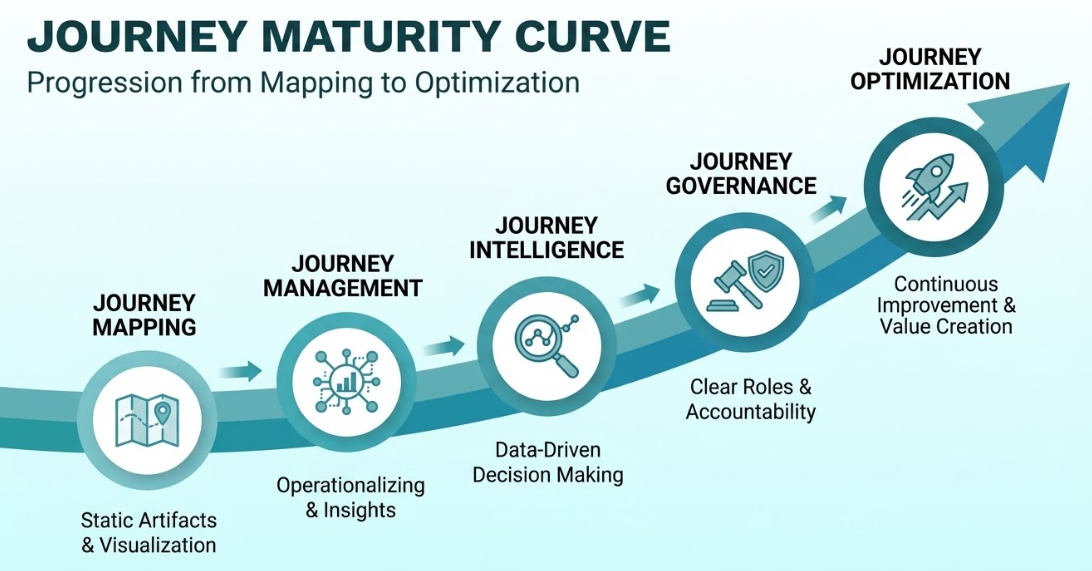
Most companies believe they’re further along than they actually are.
And here’s the uncomfortable truth: The next step isn’t a massive transformation—it’s one move forward.
This aligns closely with broader research. McKinsey finds that while 88% of organizations use AI, only a minority have translated it into enterprise-level impact, largely because workflows and operating models haven’t kept pace.
In other words, the gap isn’t awareness. It’s operationalization.
Beneva’s Story: Making Journeys Real
Beneva’s journey offers a practical blueprint.
Following the merger of La Capitale and SSQ Insurance, the organization faced three immediate challenges:
➡️ Merging two customer experiences
➡️ Aligning stakeholders
➡️ Building credibility
Their approach wasn’t to chase perfection. It was to focus on momentum:
➡️ Measure systematically to ground decisions in reality
➡️ Collaborate with believers to build early traction
➡️ Design for delivery, not just conceptual accuracy
The result?
➡️ Early pilot wins
➡️ Executive buy-in
➡️ Journey thinking elevated to a leadership-level priority
This reinforces a critical insight from the session: Journey work only creates real impact when it operates at the enterprise strategic level, not as a CX side project.
The AI Reality: Acceleration Without Abdication
AI was a central theme, but not in the way most conversations frame it.
The message was clear: AI should accelerate journey management, not replace human judgment.
In practice, AI delivers value in:
➡️ Efficiency
➡️ Insight synthesis
➡️ Next-best action recommendations
But it also introduces real risks:
➡️ Data sensitivity
➡️ Governance complexity
➡️ Trust concerns
This balanced perspective is echoed in industry research. McKinsey notes that organizations seeing the most value from AI are those that:
➡️ Redesign workflows
➡️ Embed AI into decision-making
➡️ Maintain strong leadership oversight
Similarly, broader CX research shows AI is driving measurable gains, from personalization to efficiency, but only when applied thoughtfully and at scale.
The implication:
Responsible AI isn’t a constraint; it’s a prerequisite for impact.
The Execution Gap: Where Most Programs Break Down
One of the most practical parts of the session was a simple exercise:
“What should you stop doing?”
Common answers:
➡️ Static journey decks
➡️ Annual updates
➡️ Siloed ownership
➡️ “Perfect before action” thinking
This reflects a broader truth: Progress in journey management comes from removing friction, not adding complexity.
And it aligns with a key industry trend: organizations are shifting from adding tools to simplifying execution models.
Making Journeys Actionable: The Step-Level Model
So what actually works?
The session highlighted a clear operating model for turning journeys into action:
➡️ Step-level ownership → clear accountability
➡️ Connected initiatives → link work directly to journeys
➡️ Cross-functional access → involve the entire organization
➡️ Outcome-level measurement → tie to business KPIs
➡️ Governance cadence → ensure continuous improvement
This is where journey management becomes more than a visualization; it becomes a decision system.
And that matters. Research consistently shows that customer experience is now a primary competitive differentiator, with companies increasingly competing on experience rather than product or price.
Turning Strategy Into Action: The Role of Journey Management Platforms
Of course, knowing what to do is only half the battle. Executing consistently, across teams, systems, and priorities, is where most organizations struggle.
This is where modern customer journey management platforms play a critical role.
To operationalize the step-level model discussed in the session, organizations need more than static artifacts. They need a system that connects journeys directly to the way the business runs.
Platforms like JourneyTrack enable this by:
➡️ Creating a single source of truth for journeys, eliminating duplicate versions and siloed ownership
➡️ Connecting journey steps to real data and KPIs, making performance visible and measurable
➡️ Linking insights to action, so teams can assign, track, and execute improvements across functions
➡️ Enabling governance at scale, with clear ownership, review cadences, and accountability
➡️ Embedding AI where it matters, accelerating insight generation, prioritization, storytelling, and AI agents, without removing human oversight
In this model, journeys are no longer static deliverables. They become living systems, continuously updated, measured, and improved.
And that shift is what makes the difference between organizations that understand their customer experience… and those that actually improve it.
The Bottom Line: Do the Right Next Thing
The session closed with a deceptively simple idea:
“Journey leaders don’t win by doing everything. They win by doing the right next thing.”
In a world of increasing complexity—more data, more tools, more AI—that message lands.
Because the future of journey management isn’t about more mapping, more dashboards, or more experimentation.
The future of journey management is about
➡️ Clear ownership
➡️ Measurable outcomes
➡️ Thoughtful use of AI
➡️ Relentless focus on execution
The industry is at an inflection point.
AI is accelerating. Expectations are rising. And patience for “insight without impact” is running out.
The organizations that win won’t be the ones with the most sophisticated journeys on paper.
They’ll be the ones that turn journeys into action, one step at a time.
Subscribe to our blog and stay in the know.