
Smarter Insurance Journeys with AI: From Complexity to Measurable Impact
Insurance organizations are no strangers to complexity. Between regulatory requirements, product variations, member segments, and ecosystem partners, even a “simple” journey, like enrolling in a plan or submitting a claim, quickly becomes anything but.
And yet, despite years of investment in journey mapping, many insurers are still asking the same question: Why aren’t we seeing measurable impact?
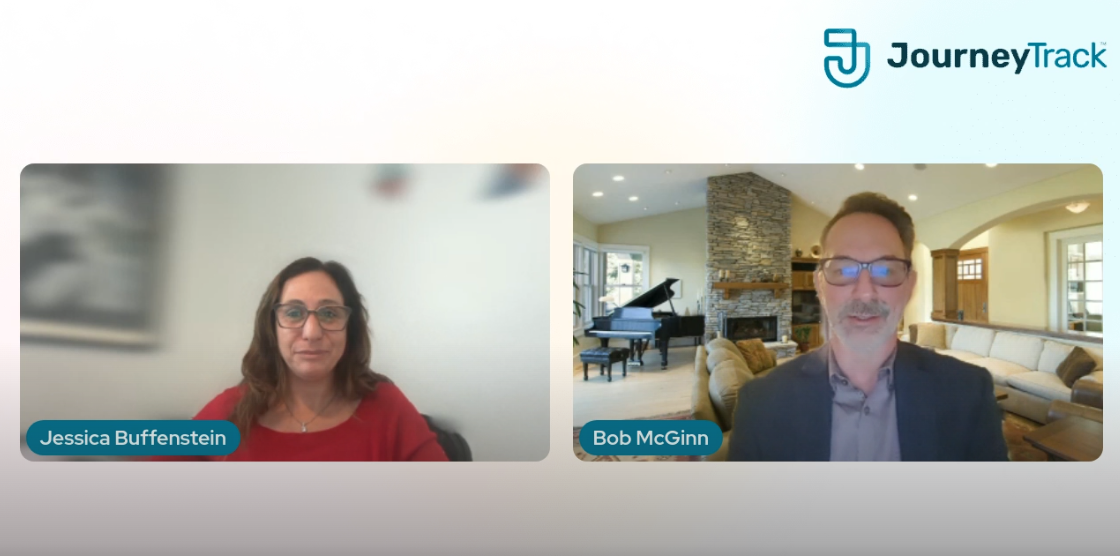
That’s exactly what we explored in our recent webinar, Smarter Insurance Journeys with AI with JourneyTrack's Bob McGinn and Blue Shield of California's Jessica Buffenstein.
The answer isn’t more maps; it’s a fundamentally different way of operating.
The CX Reality Check: Why Change Is Urgent
Let’s start with the uncomfortable truth. Customer experience is not improving.
According to Forrester, CX quality has declined for multiple consecutive years, with many brands failing to deliver meaningful improvements in effectiveness, ease, and emotion.
At the same time, customer expectations are rising. According to a 2024 article in The Future of Commerce, 71% of customers expect personalized experiences, and most are frustrated when they don’t receive them. And according to Zendesk, over 50% will switch brands after a single poor experience.
For insurers, where trust, clarity, and ease are critical, the stakes are even higher.
The takeaway: incremental improvements aren’t enough. A structural shift is required.
The Core Problem: Mapping Without Managing
Most insurance organizations have journey maps.
But those maps often live as workshop outputs, PowerPoint artifacts, and static snapshots of a moment in time.
The gap? Execution.
As discussed in the webinar, journey mapping is static, whereas journey management is dynamic.
Mapping shows you what’s happening.
Management ensures something gets done about it.
As Forbes puts it, this distinction is becoming increasingly important as CX evolves into a cross-functional, enterprise-wide discipline—not just a CX team initiative.
Why Insurance Journeys Are Uniquely Complex
Insurance journeys aren’t linear—and they’re rarely consistent.
A single “member journey” can vary dramatically based on:
➡️ Plan type (Medicare, Medicaid, employer-sponsored, individual)
➡️ Geography (rural vs. urban access)
➡️ Product structure (HMO vs. PPO)
➡️ Persona needs and health conditions
The result? Thousands of journey variations.
Without a system to connect and manage these journeys, organizations end up with:
➡️ Fragmented insights
➡️ Duplicated efforts
➡️ Missed opportunities for improvement
This is where the concept of a “journey atlas” becomes critical: creating visibility into how journeys interrelate across the ecosystem.
Enter AI: The Accelerator, Not the Answer
AI is rapidly reshaping what’s possible in customer experience.
McKinsey reports that AI-driven “next best experience” capabilities can:
➡️ Increase customer satisfaction by 15–20%
➡️ Boost revenue by 5–8%
➡️ Reduce cost to serve by 20–30%
But here’s the nuance, and where many organizations go wrong: AI doesn’t replace journey management. It accelerates it.
In the context of insurance journeys, AI enables teams to:
➡️ Synthesize huge amounts of VoC, research, and operational data
➡️ Generate journey maps, personas, and insights in minutes
➡️ Identify pain points and opportunities faster than ever
➡️ Ensure journeys are updated with the latest data
As highlighted in the webinar, what used to take weeks can now happen in minutes.
But AI alone doesn’t drive outcomes.
The Critical Role of Human Judgment
Despite rapid advancements, AI still lacks:
➡️ Contextual understanding of complex organizations
➡️ Accountability for decisions
➡️ Empathy for customers navigating high-stakes moments (like healthcare or claims)
That’s why leading organizations are taking a human + AI approach:
➡️ AI for speed, scale, and pattern recognition
➡️ Humans for validation, context, and cross-functional collaboration
Even Forrester emphasizes that while AI will improve self-service and automation, its success depends on how organizations integrate it into broader operational models—not just deploy the technology.
From Insight to Action: The Operating Model Shift
Perhaps the most important takeaway from the webinar: Technology alone doesn’t create impact. Operating models do.
Many organizations fall into the trap of focusing on tools first.
But sustainable success comes from building the muscle of journey management.
That includes:
➡️ Cross-functional ownership of journeys
➡️ Governance and prioritization frameworks
➡️ Clear accountability for action
➡️ Continuous measurement and optimization
This aligns with broader CX trends, where organizations are shifting toward AI-enabled ecosystems, like JourneyTrack, that connect data, teams, and decisions.
In other words:
The future of CX isn’t just better insights—it’s better execution.
Where to Start: Prove Value Quickly
One of the most practical lessons from the session: Don’t try to boil the ocean.
Instead:
➡️ Start with one high-impact journey (e.g., claims or prior authorization)
➡️ Connect insights, data, and actions
➡️ Demonstrate measurable outcomes
➡️ Scale from there
This approach not only proves ROI; it builds credibility and momentum across the organization.
The Bigger Shift: Toward Journey-Centric Organizations
Ultimately, this isn’t just about improving journeys. It’s about transforming how insurance organizations operate.
A journey-centric insurance organization:
➡️ Aligns teams around member goals, not internal silos
➡️ Connects data to real-world experiences
➡️ Uses AI to accelerate insight and action
➡️ Continuously optimizes outcomes across the lifecycle
And perhaps most importantly:
➡️ It treats customer experience as a driver of business performance, not a side initiative.
For more detail, watch the webinar.
In the end, insurance journeys will only get more complex.
Customer expectations will only rise.
And AI will only accelerate the pace of change.
The organizations that win won’t be the ones with the best maps.
They’ll be the ones who turn journeys into a system for decision-making, action, and measurable impact.
Subscribe to our blog and stay in the know.