
From Maps to Decisions: Takeaways From Forrester CX Forum West
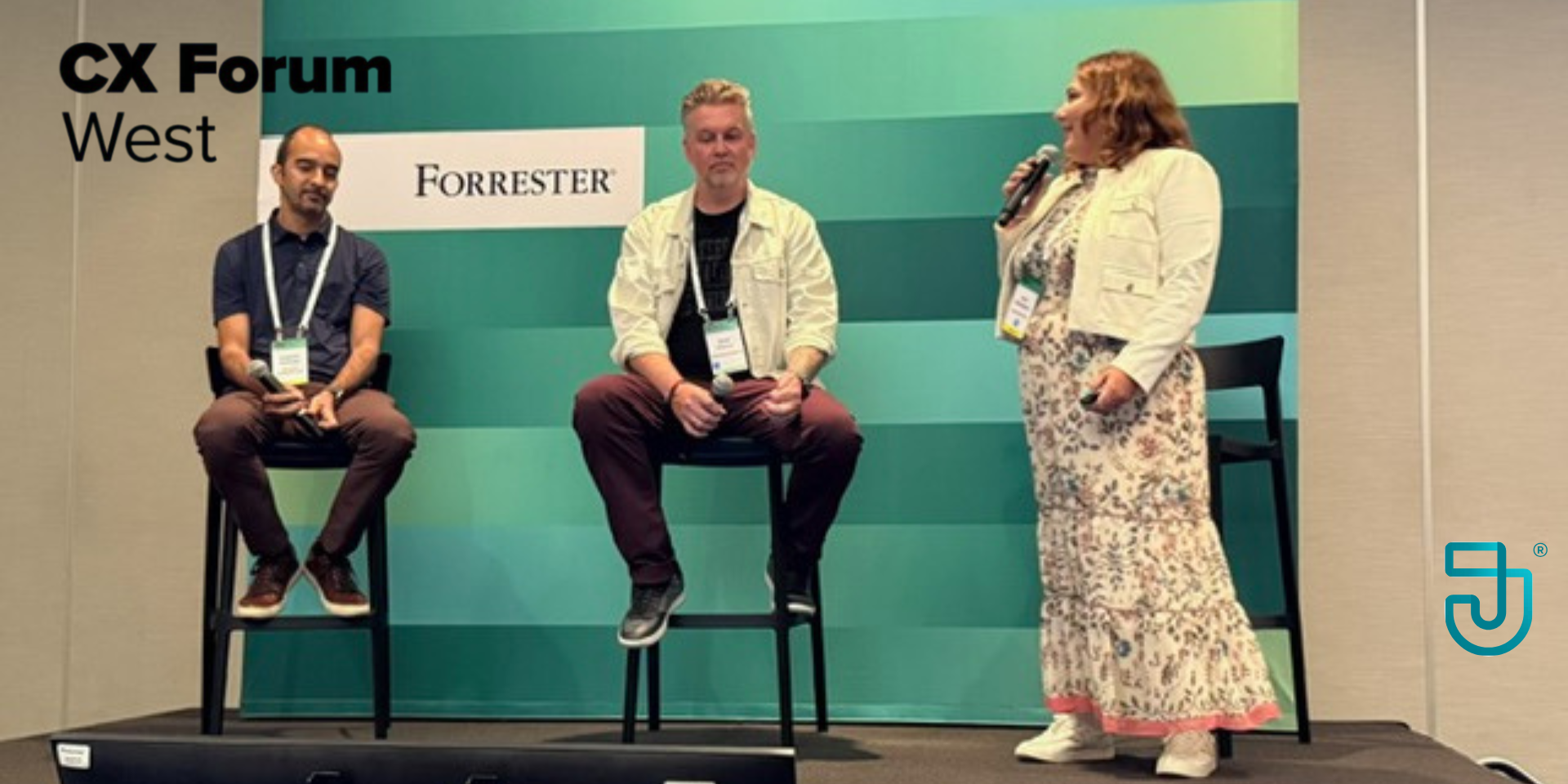
Forrester CX Forum West brought together CX, marketing, digital, design, and business leaders around a timely theme: how organizations can build experiences that AI alone can’t.
Across the agenda, one idea showed up again and again: AI is moving fast, but better customer experience still depends on the human foundations behind it. Trust. Clarity. Governance. Strategy. Operational alignment. The work that makes AI useful, responsible, and measurable.
That was exactly the conversation JourneyTrack was proud to contribute as a sponsor at the event. We had the opportunity to present alongside First Horizon Bank and Key Lime Interactive in our case study session, “Governance First: Scaling Journey Management With AI.”
The session focused on a challenge many enterprise CX teams know all too well: organizations have invested heavily in journey mapping, but maps alone rarely create the operational consistency or measurable business impact leaders need.
Because journeys don't keep executives up at night.
Decisions do.
Which customer problem should we solve first? Where should we invest? Who owns the work? How will we know whether it moved the business? And how do we make those decisions consistently across teams, lines of business, systems, and priorities?
That is where journey work has to evolve.
Journey Maps Create Context. Governed Decisions Create Momentum.
Journey maps have long been one of the most useful ways to understand customer experiences. They create shared visibility. They help teams see where customers struggle. They give organizations a more human, connected view of what is often scattered across channels, departments, and data sources.
But as First Horizon's Strat Parrott shared during the session, maps can also stall.
Without a common language, taxonomy, lifecycle, hierarchy, standards, and ownership model, journey work can become a collection of disconnected artifacts. Teams may have maps, but no continuity. Workshops, but no operational model. Insights, but no clear path to action.
The result is familiar: lots of effort, lots of documentation, and not enough decisions.
First Horizon’s message was refreshingly practical. The goal is not to create prettier maps. The goal is to build a more scalable operating model for journey work.
That meant moving governance from an afterthought to the front.
The Journey Atlas Matters
One of the most powerful ideas from the First Horizon story was the importance of creating enterprise visibility across journeys.
In many organizations, different teams are doing valuable journey work, but that work often lives in different formats, tools, documents, or business units. Without a shared structure, it becomes difficult to know what exists, what overlaps, what is outdated, and where the biggest opportunities are.
First Horizon approached this by creating a journey atlas first, giving the organization a more connected view of its journey ecosystem. That enterprise visibility helped support stakeholder alignment, a common language, and stronger adoption.
This is a critical shift.
Journey governance is not bureaucracy for bureaucracy’s sake. Done well, it creates the conditions for speed. It gives teams a shared foundation so they can prioritize, collaborate, and make better decisions without reinventing the wheel every time.
Governance helps answer questions like:
➡️ What is the official version of this journey?
➡️ Who owns it?
➡️ Which personas, moments, insights, metrics, and actions are connected to it?
➡️ Where are there dependencies across teams?
➡️ What work is already underway?
➡️ What outcomes are we trying to influence?
Those questions are not administrative. They are strategic.
AI Needs a Foundation
AI was everywhere at Forrester CX Forum West, and for good reason. AI is changing how teams research, analyze, design, summarize, and act on customer experience work. But the strongest conversations were not about simply adding AI for AI’s sake.
They were about making AI practical.
That distinction matters.
AI can help teams move faster, identify patterns, summarize large volumes of information, and surface opportunities that might otherwise be missed. But without governance, AI can also amplify the mess. If the underlying journey data is fragmented, inconsistent, or disconnected from ownership and outcomes, AI may generate more noise than signal.
First Horizon’s story reinforced an important lesson: governance should come before AI at scale.
When organizations establish a shared journey taxonomy, common standards, connected data, and clear ownership, AI has something meaningful to work with. It can operate within context. It can support decision-making instead of producing another layer of disconnected outputs.
That is the practical path from journey mapping to journey intelligence.
From Journey Management to Decision Intelligence
At JourneyTrack, we believe the next evolution of journey work is decision intelligence for customer journeys.
That means helping organizations decide:
➡️ What to fix
➡️ In what order
➡️ Why it matters
➡️ Who owns it
➡️ Whether it worked
The journey itself is not the end goal. The journey provides the context.
The real value is in improving the decisions that shape customer experiences and business outcomes.
That is why governance, journey portfolios, connected insights, metrics, ownership, and AI all need to work together. When they operate independently, teams end up with more artifacts. When they operate together, teams can move from scattered journey work to a disciplined, measurable decisioning model.
This is especially important in complex, regulated, enterprise environments where customer experience work spans multiple functions and decisions carry real operational weight. In those organizations, success depends on more than enthusiasm. It depends on structure.
Expert Support Helps Teams Scale
Key Lime Interactive brought another important perspective to the conversation: not every organization has the internal bench strength to scale this work alone.
Sometimes the gap is team size. Sometimes it is specialized skill. Sometimes teams need help moving from ambiguity to clarity, or from platform potential to operational adoption.
That is where expert support can make a meaningful difference.
Key Lime’s role in the journey from maps to management to decision intelligence is rooted in human-centered CX and UX research, service design rigor, and implementation support. Their work helps organizations reduce risk, validate user needs, and translate strategy into action.
Because technology alone does not create adoption. People do.
The most successful organizations combine the right platform, the right governance model, the right research discipline, and the right change support. That combination helps teams move faster without losing the human context that makes CX work meaningful in the first place.
The Biggest Lesson: Stop Adding Artifacts. Start Improving Decisions.
The throughline from the JourneyTrack, First Horizon, and Key Lime Interactive session was simple:
Scalable journey work starts when governance, intelligence, expert support, and practical AI work together.
Not independently. Together.
For organizations that already have journey maps, the question is not, “How many maps do we have?”
The better question is, “Are those maps helping us make better decisions?”
If the answer is unclear, that is the opportunity.
Because the future of CX will not be won by the teams with the most artifacts. It will be won by the teams that can connect customer understanding to operational action, business outcomes, and measurable improvement.
That is the work JourneyTrack is focused on.
And it is why Forrester CX Forum West was such a powerful moment to have this conversation with First Horizon, Key Lime Interactive, and the broader CX community.
The next era of journey work is not just about seeing the customer experience more clearly.
It is about deciding what to do next, and knowing whether it worked.
Ready to Move From Maps to Decisions?
If your organization has journey maps, but still struggles to decide what to fix, where to invest, who should own the work, or whether improvements are actually moving the business, it may be time to assess your decisioning maturity.
Take JourneyTrack’s 3-minute Decisioning Assessment to see where your organization stands, and where stronger governance, intelligence, and practical AI can help you scale journey work with more confidence.
Take the Decisioning Assessment
Or, if you’re ready to see how JourneyTrack helps teams move from scattered journey artifacts to governed, measurable decisions, schedule a demo.
Subscribe to our blog and stay in the know.